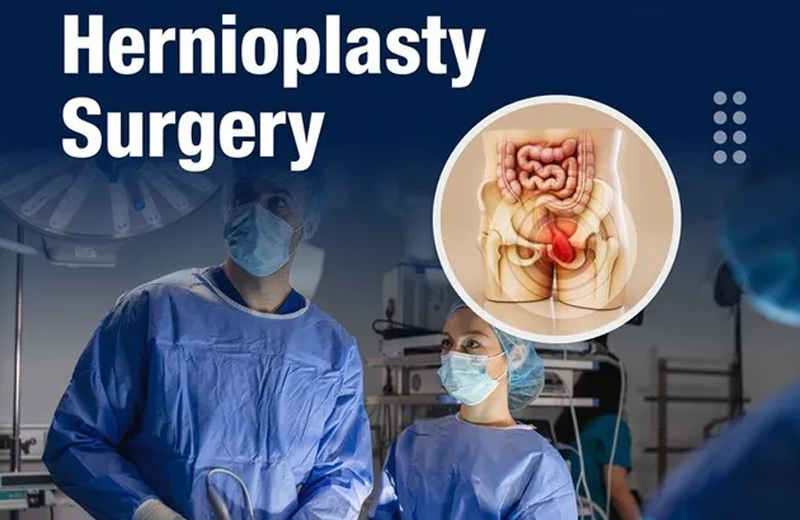
Hernioplasty is a surgical procedure used to repair a hernia by strengthening the weakened area of the abdominal wall, often with the help of a surgical mesh. It can provide effective treatment for suitable patients and help prevent complications associated with an untreated hernia.
Hernioplasty is a surgical method of repairing a hernia in which the protruding tissue is returned to its appropriate position and the weakened abdominal wall is reinforced. A surgical mesh may be placed over or around the weakened area to provide additional support and reduce the risk of recurrence.
Common symptoms associated with a hernia that may require surgical evaluation include:
Hernias occur when an area of the abdominal wall becomes weak and internal tissue pushes through it. This weakness may be present from birth or develop over time. Increased pressure inside the abdomen can contribute to the development or worsening of a hernia.
Repeated heavy lifting or strenuous activity can increase abdominal pressure.
Persistent coughing can repeatedly increase pressure on the abdominal wall.
Frequent straining during bowel movements may contribute to hernia formation.
Weakness around a previous surgical incision can result in an incisional hernia.
Hernias are usually diagnosed through a physical examination. The doctor may examine the affected area while the patient is standing, coughing, or straining. Ultrasound, CT scan, or other imaging tests may be recommended when the diagnosis is unclear or to assess a complex or recurrent hernia.
Consult a doctor if you notice a new or enlarging bulge, persistent pain, discomfort, or difficulty with daily activities. Seek urgent medical attention if the bulge becomes suddenly painful, firm, cannot be pushed back, or is associated with vomiting, abdominal pain, or difficulty passing stool or gas.
Treatment depends on the type, size, location, symptoms, and overall health of the patient. While some small and minimally symptomatic hernias may be monitored, symptomatic or complicated hernias may require surgical repair.